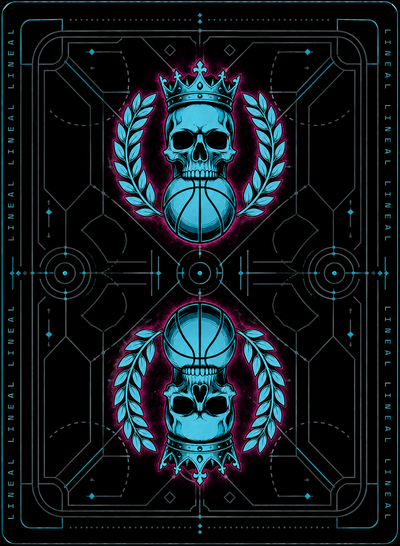
A card game for two, where one on one is the mechanic, not the theme.
Working title · A concept by Pamplemoose Games
Six minutes. First to eleven. Make it and keep it. A ten count when a possession stalls. A final minute where every value doubles and the rebounds come alive. Four divisions, and a belt whose whole meaning is the chain of who held it before.
We didn't build a card game and paint LINEAL on the box. We read your rules and built the game that was already in them.
Fifteen offensive and fifteen defensive per player. Thirty cards is a complete game, so a starter is a real product rather than a demo.
A three by three grid. Inside the arc pays one. Behind it pays two. Every trip begins at the check, exactly the way yours does.
Score and you keep the ball. Miss and it's theirs. Round six is Duel Time, and it doubles everything on the board.
Roughly fifteen minutes a match.
The arc bulges the way it does on a real half court, so the wings sit behind it and pay two while the free throw area sits inside and pays one.
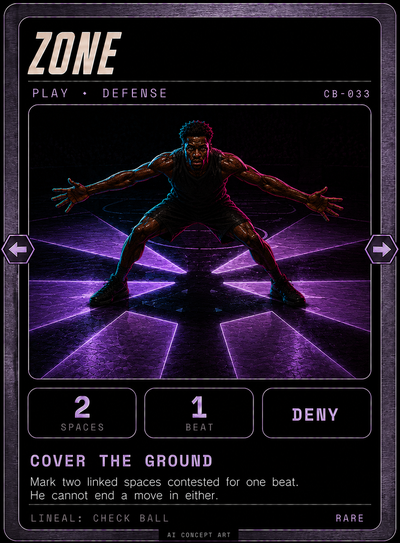
You start every trip at the top of the key. The rim is two moves away through the middle. The deep corners take all three, which is your entire possession. Movement runs along the lines only, so there is no diagonal shortcut and a defender who sits in the middle genuinely closes the paint.
Draw three, play one, discard two, and move one space. Your opponent does the same thing at the same time.
Both cards go down face down and flip together. A defender in a real one on one commits before the handle finishes, so nobody here gets to answer a move they already watched.
Three beats, then you have to shoot. That's your ten count, and it is the only clock this game needs.
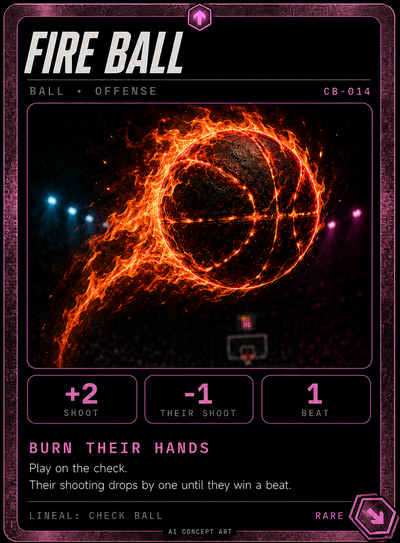
The reveal is the shot. What you played plus your shooting, against what they played plus their defense, adjusted by the separation you bought and the space you are standing on. No dice.
Make it and you keep the ball and go back to the check. Miss and it's theirs.
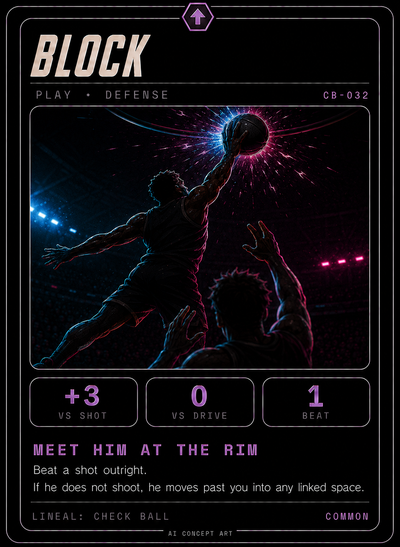
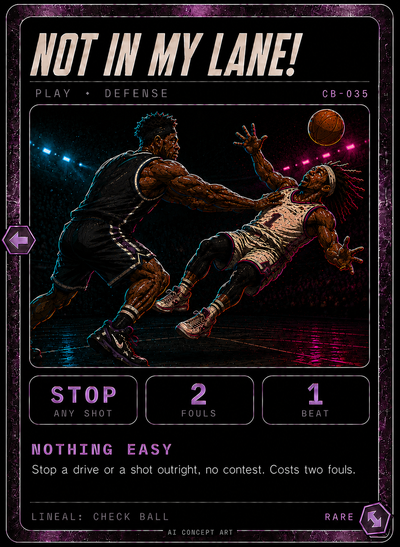
A steal attempt beats a possession that is still working. If he shoots into it, your own defense is negated for that beat rather than simply beaten, so the gamble costs a great defender more than a poor one. That is the right way round, because in a real game it is your best defender missing that wrecks you.
A block attempt is the mirror. It beats a shot. If he does not shoot, he walks around you into a better space.
So on every beat the defender is answering one question. Is he going up this beat, or still working. On the third beat he has to shoot, so the read narrows and the possession ends in a clash. Your ten count is what makes that happen.
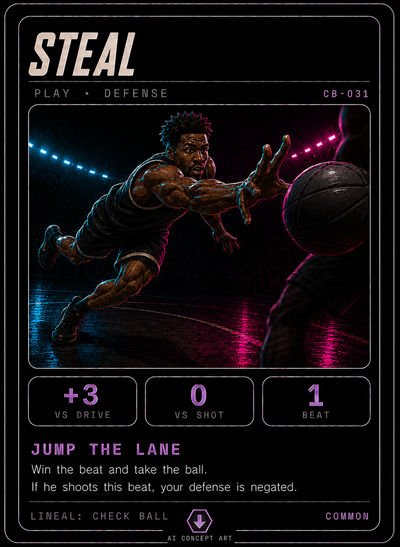
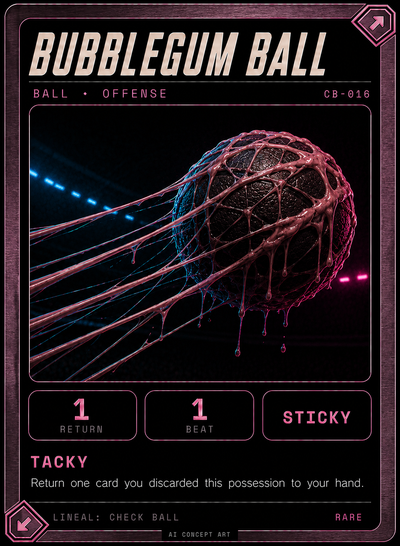
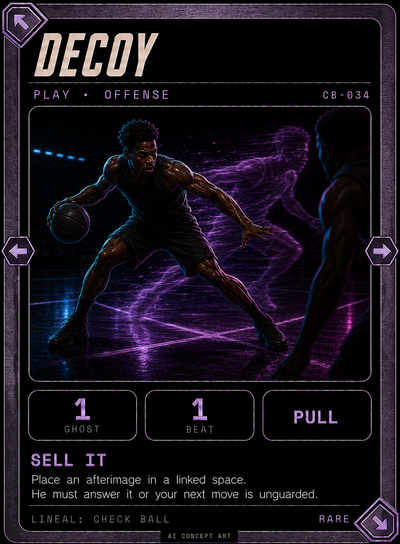
When you move, the card you just played stays behind in the space you left. So a possession writes itself across the court as you go.
Cards carry arrows on their edges. When two of them point at each other, they link. A drive that actually goes somewhere leaves a connected line and a better look at the rim. A possession that wanders leaves a mess on the floor. Your defender is placing on the same nine spaces, and playing over a card replaces it, so the floor is contested the whole way.
Your league is named after the mechanicYour final minute is already a card game climax, so we kept it whole. Every value doubles and the rebounds come alive.
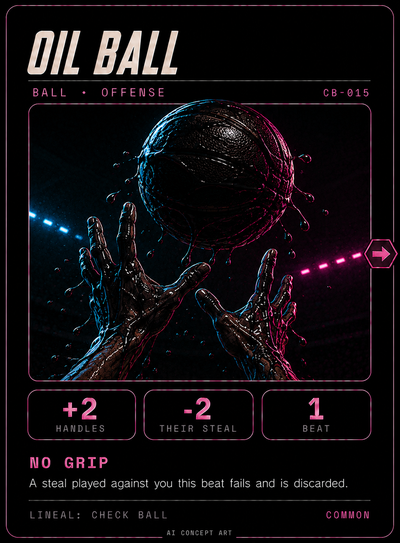
An offensive board gets finished where it lands. A defensive board has to be cleared back behind the arc before it can score, which is a real trip across the grid. It is also the round where the heavyweights finally eat, because contesting a live ball is the thing big men do.
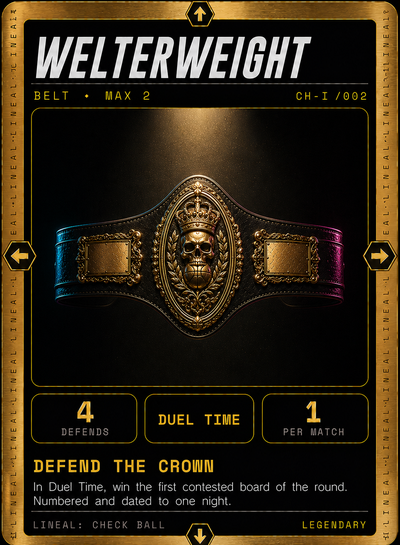
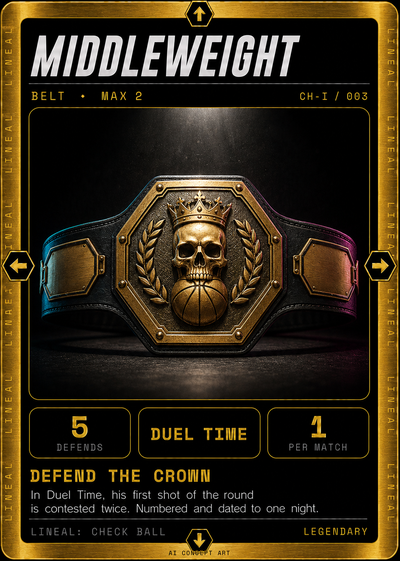
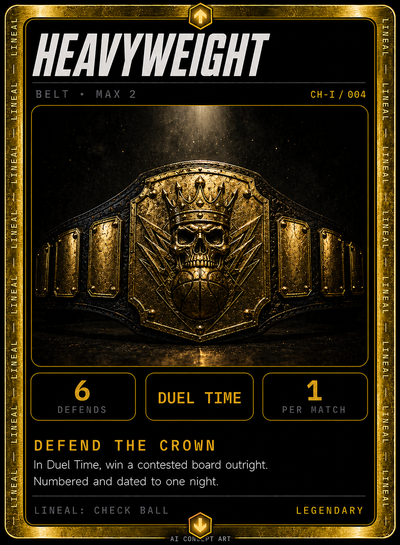
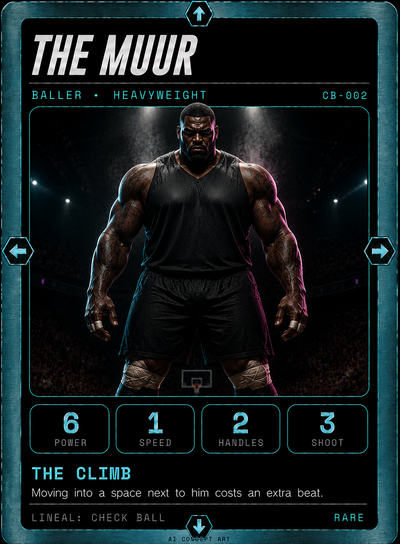
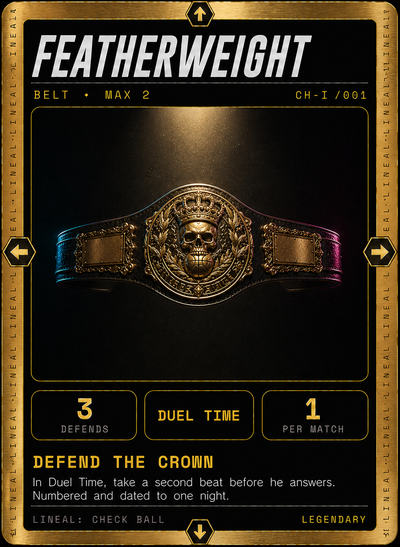
Belt cards are the rare type, and a deck may run up to two. There are four belts for four divisions, each with one signature ability that never changes, so the game stays balanced forever while the name and the face on the card keep changing.
Every fight night crowns a champion. That champion's belt card gets printed, numbered and dated, and the one before it becomes history. Your calendar turns into a release schedule, and the chain of who beat whom turns into a chain of real cards that only you can print.
Scarcity here is not manufactured. It comes from a real result on a real night, which is the one thing a card company cannot fabricate and the one thing you already produce every month.
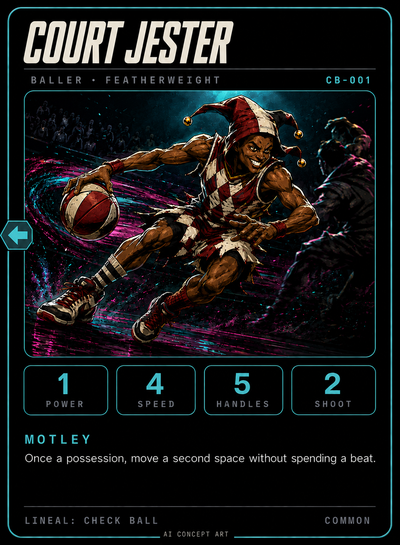
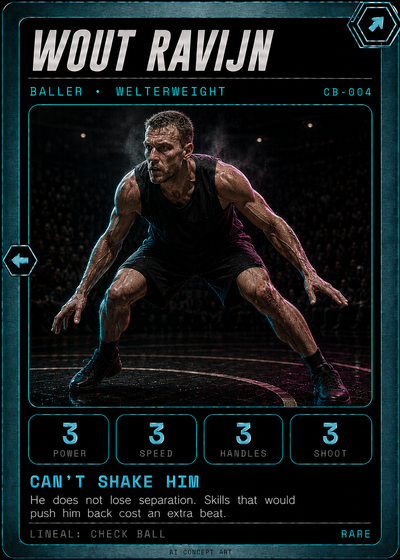
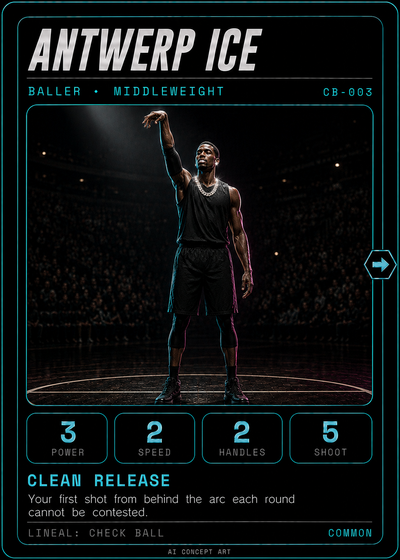
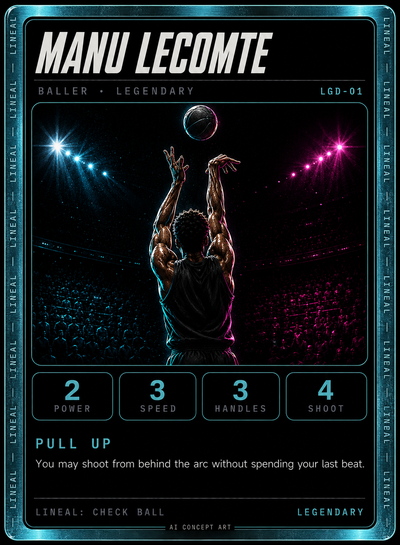
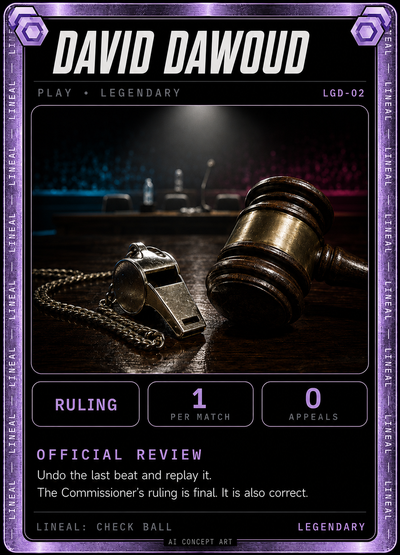
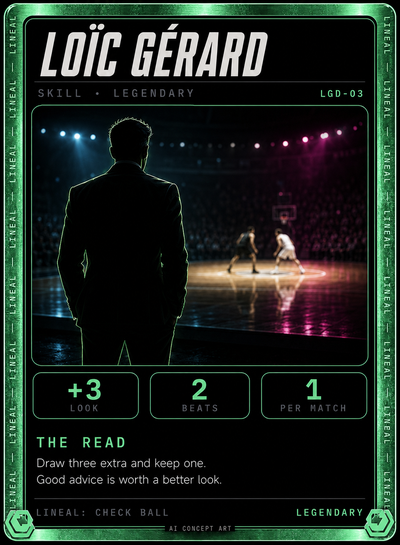
We built all three without your faces on purpose. Nobody should find their own likeness on a card they never agreed to. Say the word and we'd do it properly, with a commissioned illustrator and your sign off.
Analyst estimates for the collectible card game market run anywhere from roughly eight to twenty billion dollars depending on what gets counted, and they disagree about almost everything except the direction. Cards turn a fan who watches into a fan who plays, and a fan who plays comes back between fight nights.
You already tell your league in chapters, so the sets are named and scheduled before we start. One set is a game. A chapter every season is a franchise. Every character, belt and card in it stays yours.
Zack Howe and Cole Beardsley. Our flagship credential is HAVOC: Gen Zero, the card game we designed, funded on Kickstarter in under thirty minutes. We build card games around existing worlds for a living, and the derivation work is the part we care most about.
The next step is a conversation about scope. We would rather size this together than guess at a number on a slide. And if a card game is not where LINEAL wants to spend attention this year, that is a fair answer and this was still a good conversation.
Let's check the ball →Zack Howe & Cole Beardsley · Pamplemoose Games · zack@pamplemoosegames.com
Concept pitch prepared by Pamplemoose Games LLC for LINEAL BV. All LINEAL brand assets, names, rules and imagery appear solely to demonstrate this concept and remain the property of their owners. Game mechanics and designs are original work of Pamplemoose Games LLC. Placeholder art only; final art would be commissioned. AI never touches the game design. Not for distribution.